

The Tai Po Fire Is Out. The Long Term Work Has Just Begun.

This is a linkpost for https://www.linkedin.com/pulse/tai-po-fire-out-long-term-work-has-just-begun-kenneth-chan-xmmmc/ Published on November 28, 2025
In the wake of the Tai Po fire, many have rightly weighed in on what must be done urgently. Fire regulation, enforcement, and immediate safeguards dominate the conversation.
But what must not be forgotten is that the impact of this fire on the community will be on a historical scale.
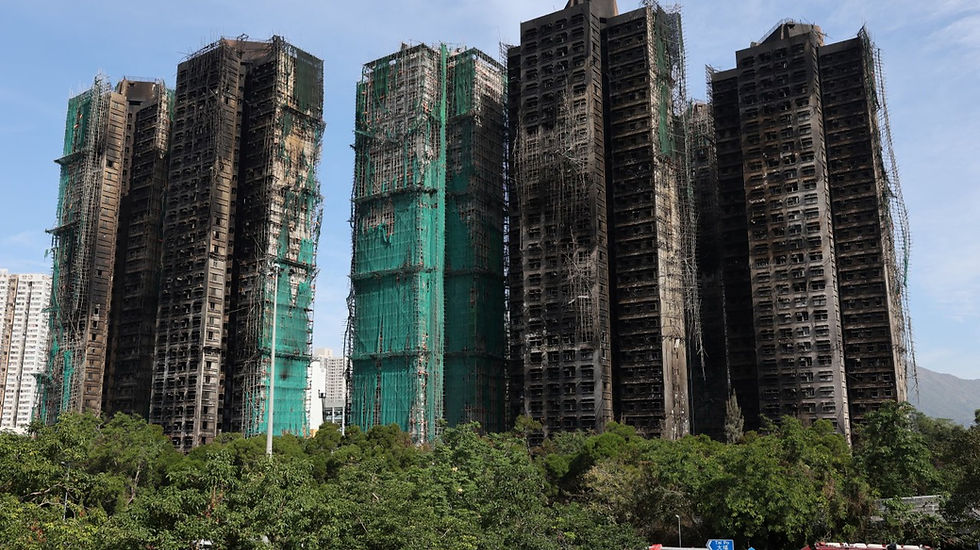
Not only will the site of the fire continue to be a memorial, this disaster will weigh on the balance of Hong Kong society for decades to come.
If we expect the fire to be over as soon as it's put out, that would be a mistake. If we expect the fire to be over as soon as those culpable are brought to justice and the investigation is over, that would be a mistake. If we expect the fire to be over as soon as regulatory updates are complete, that would be a mistake. And if we forget the long-term impact on the psyche of Hong Kong, that would be a grave mistake indeed.
A Scale of Impact We Must Not Underestimate
The 1962 fire in Sham Shui Po (44 fatalities, hundreds displaced) and the 1996 Garley Building fire (41 fatalities) left a permanent scar on our city's memory. The 2017 Grenfell Tower fire in London (72 fatalities) remains an open wound, a testament to how a single night can unravel community trust for a generation. And the Tai Po fire exceeds them all as the death toll has reached at least 128 at the moment I write this, with hundreds still missing, and thousands are left homeless.
These are not mere statistics; they are precedents. They show that a disaster's most enduring damage is not to concrete and steel, but to a city's social and emotional fabric. The trauma for those directly affected is profound. Not only will the site of the fire continue to be a memorial, the weight of this disaster will weigh on the balance of Hong Kong society for years and decades to come.
What Does This Mean For Us Now?
The resilience of Hong Kong people means that rather than remaining passive, people have immediately rallied to volunteer, to support those whose lives have been so unceremoniously torn down. This civic-mindedness is our greatest asset in the immediate crisis.
But when the urgency of the moment fades in the coming weeks and months, when the vicissitudes of quotidian life regain their dominance on our minds, what then?
At the end of a film, the credits roll, but it's often the case that it is in fact not the end of the story. The characters are left to live with the consequences. We cannot allow this fire to transform into a furnace of irresolution.
From Putting Out Fires to Preventing Conflagrations
The late great Singaporean statesman Lee Kuan Yew spoke "in terms of the next generation, in terms of the next one hundred years, […] the next thousands years" and even "in terms of eternity." According to him, it is those who think on that scale who deserve to persist.
Our required shift in mindset is not just from short-term profit to longer-term safety in construction. It is not just about putting out fires when they arise, because sometimes it is too late once we have created the conditions that allow a fire to start. It is not just a plan for the coming years of Hong Kong's economic and urban development.
It is a move from a near-term to a long-term timescale of safeguarding our next generations. It demands we ask: What are the other catastrophic risks we are overlooking, the latent conditions that could erupt into future conflagrations?
The physical fire is out. The much harder task is to ensure the embers of this tragedy forge a stronger, more foresighted city.
A question for you
Beyond the obvious, what are the latent "conditions" or systemic risks in our city or in our world that we are currently overlooking, and how do we start addressing them with a generational mindset? I would love to hear your thoughts


Comments